A new study led by PRIMUS members Catarina V. Guerreiro and Bror Jonson investigates how Saharan dust, coastal upwelling and ocean circulation interact to regulate marine productivity and carbon export in the Canary Current System.
By combining satellite observations, Lagrangian particle tracking and deep-ocean sediment-trap records, the study shows that the processes stimulating biological production at the ocean surface are not necessarily the same as those controlling how efficiently carbon is transferred to the deep ocean. In particular, Saharan dust may influence carbon export not only by supplying nutrients to surface waters, but also by providing mineral ballast that facilitates the sinking of organic particles.
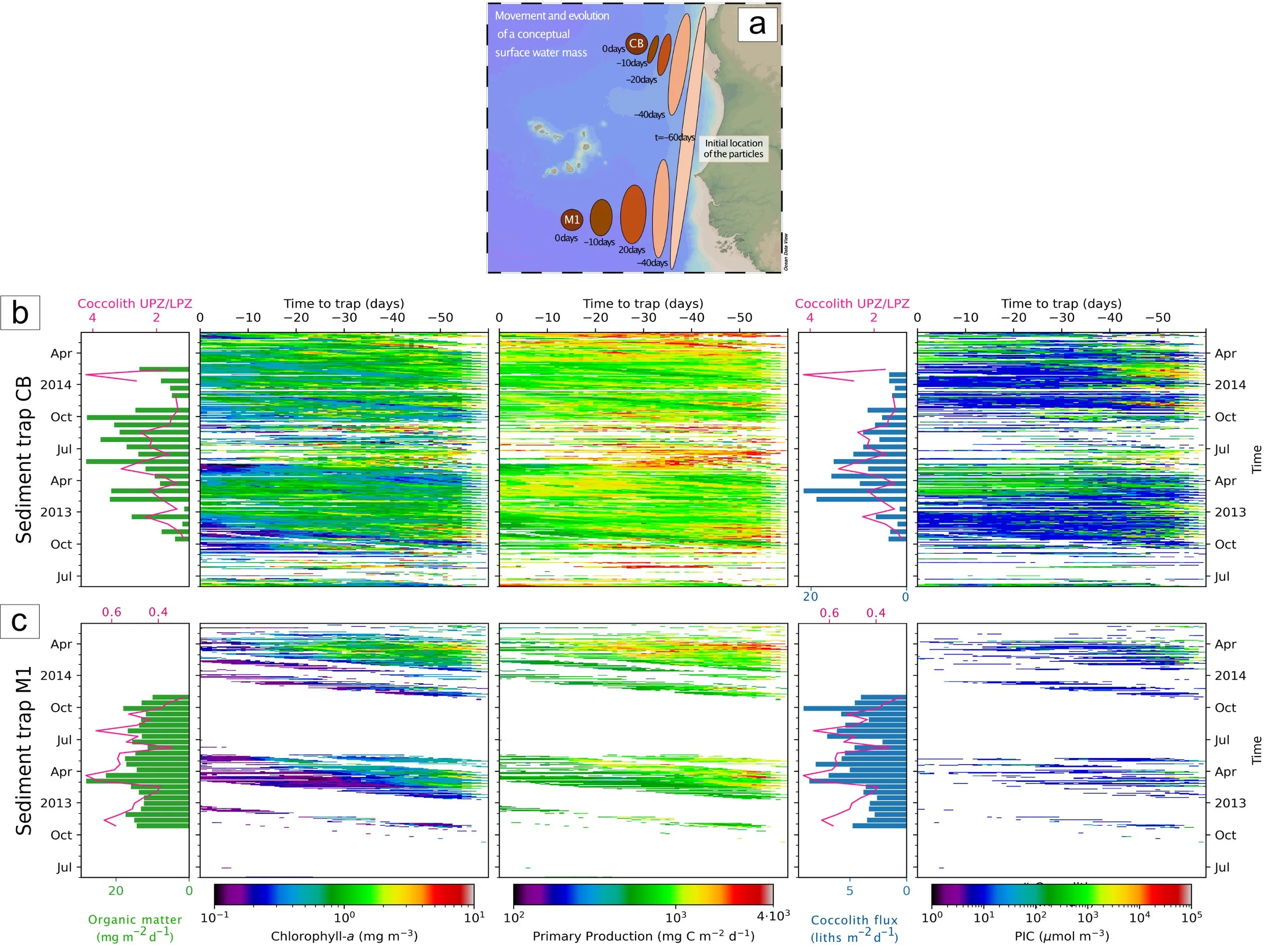
Lagrangian reconstruction of surface-water pathways connecting the NW African margin with sediment traps CB and M1 (1200 m depth), integrating satellite-derived chlorophyll-a (Chl-a), primary production (PP) and particulate inorganic carbon (PIC) with in situ fluxes of organic matter and coccoliths. Backtracking extends up to 60 days before particle arrival at the traps. Figure credits: Schlitzer, R., Ocean Data View, odv.awi.de.
Coccolithophores — calcifying phytoplankton central to PRIMUS research — provided an important biological tracer of these interactions, helping to connect changes in surface-ocean conditions with particle export at depth. The study contributes to a better understanding of how atmosphere–ocean interactions and plankton ecology shape the biological carbon pump in one of the world's most productive and dust-influenced ocean regions.
Read the paper: https://bg.copernicus.org/articles/23/5133/2026/
Guerreiro, C. V. et al. 2026. Seasonal upwelling–dust controls on export production in the Canary Current System revealed by Lagrangian particle tracking, Biogeosciences, 23, 5133–5161, https://doi.org/10.5194/bg-23-5133-2026.